Category: Market Insights & Trading
DeFi Token Swaps: What to Know Before You Trade
· 5 MIN READ
Learn how DeFi token swaps work fees, slippage, liquidity pools, and key risks every trader should understand before using decentralized exchanges. Safely now!
What You Must Know About DeFi Token Swaps Before Trading
If you’ve ever tried to exchange one currency for another directly, cutting out the middleman, you’ve likely encountered the concept of a "swap." But there’s more to it than just hitting a button. When capital is on the line, the technical details are what separate profit from loss. In today’s financial markets, DeFi token swaps have emerged as a powerful tool, allowing you to retain full ownership of your assets while managing your portfolio, all without needing to trust a third-party company or bank.
Many assume the process is simple, but failing to understand the mechanics behind the scenes—like liquidity pools—can lead to hidden costs eating into your funds. We aren’t here to play word games; the goal is to explore how you can use this tool to improve your financial performance and identify the risks lurking in the shadows. If you are looking for financial independence and speed in your transactions, understanding this process is absolutely essential.
What Are DeFi Token Swaps?
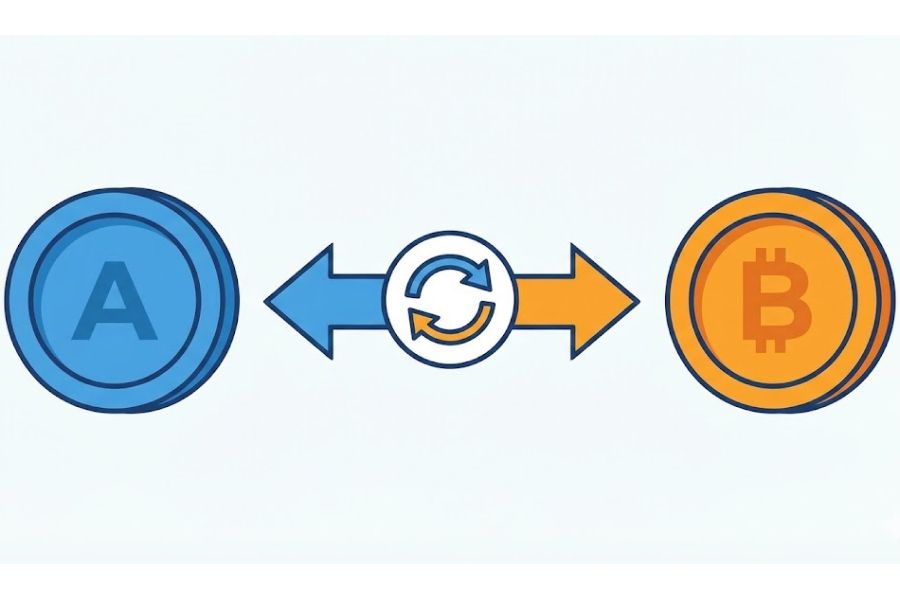
In its simplest definition, a token swap in the DeFi space means you give Asset A and receive Asset B, without any central entity like a bank or a centralized exchange intervening. Everything is managed by pre-programmed code, known as smart contracts. This makes token swaps in DeFi one of the most secure methods for transferring value, provided you know what you are doing. The key difference here is that you don’t need to deposit your assets into an exchange wallet; your funds remain in your personal wallet until the very last second.
These types of swaps give you freedom. Imagine you want to invest in a new project that hasn't been listed on major exchanges yet. Your only route is through decentralized platforms. Here, there are no long KYC queues or frozen accounts. Everything is transparent and recorded on the blockchain. However, you must note that the responsibility for wallet security and transaction approval lies 100% with you, and there is no central support to reverse mistakes.
In this landscape, tools exist that make the experience smoother and safer for users. For instance, GIDEX (GINOX Decentralized Exchange) is designed on this exact principle. It is a non-custodial exchange, meaning it has no access to your assets, and there is no need for identity verification (No KYC). You can easily perform your swaps there, and even use advanced features like cross-chain bridges to convert Ethereum to BNB. Security is paramount on such platforms because the wallet is managed directly by you.
How Token Swaps Work in DeFi
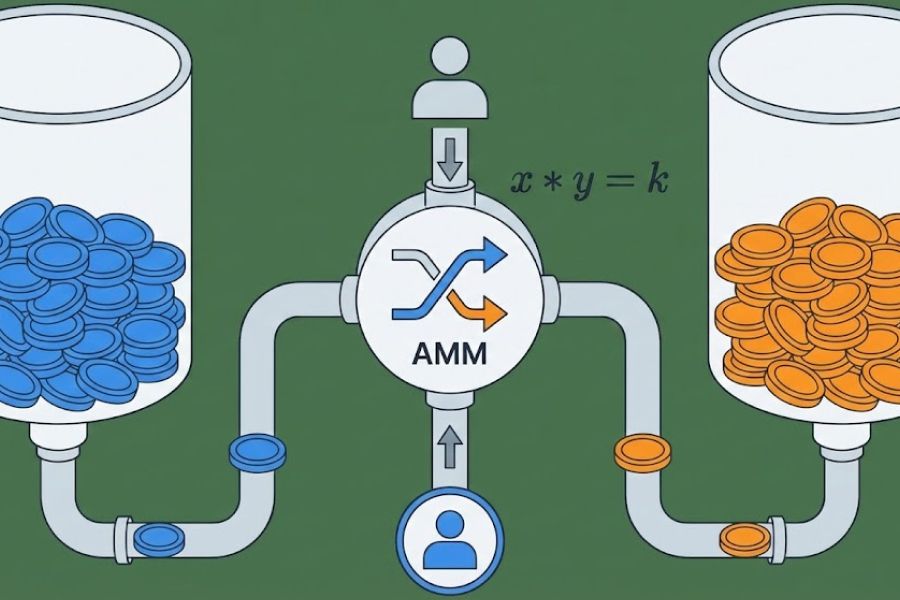
To understand how crypto token swaps are executed, you need to discard the "Order Book" mentality found in stock markets or centralized exchanges. Here, buyers and sellers don't connect directly. Instead, you trade against a Liquidity Pool. These pools are filled with pairs of tokens provided by other users. When you want to convert your Ethereum to Tether, you are essentially pouring Ethereum into the pool and taking out the equivalent amount of Tether. The price is determined by a mathematical formula to maintain the pool's balance.
This mechanism, known as an Automated Market Maker (AMM), ensures there is always liquidity for trading, unless the pool is completely drained. The speed of decentralized token swaps is incredibly high because you aren't waiting for a seller to be found. The smart contract immediately calculates the price and finalizes the transaction. Of course, this speed and automation require robust infrastructure so transactions don’t get stuck in the network or gas fees don’t skyrocket.
The math behind this is usually a simple formula: $x * y = k$. This means the product of the number of tokens in the pool must always remain constant. When you buy Token A, you reduce its supply in the pool, so according to the formula, its price increases slightly for the next person. This is what causes instantaneous price changes. Understanding this simple mechanism helps you realize why the final price differs from the initial price in large-volume trades and why pool liquidity is so critical.
Fees, Slippage, and Price Impact
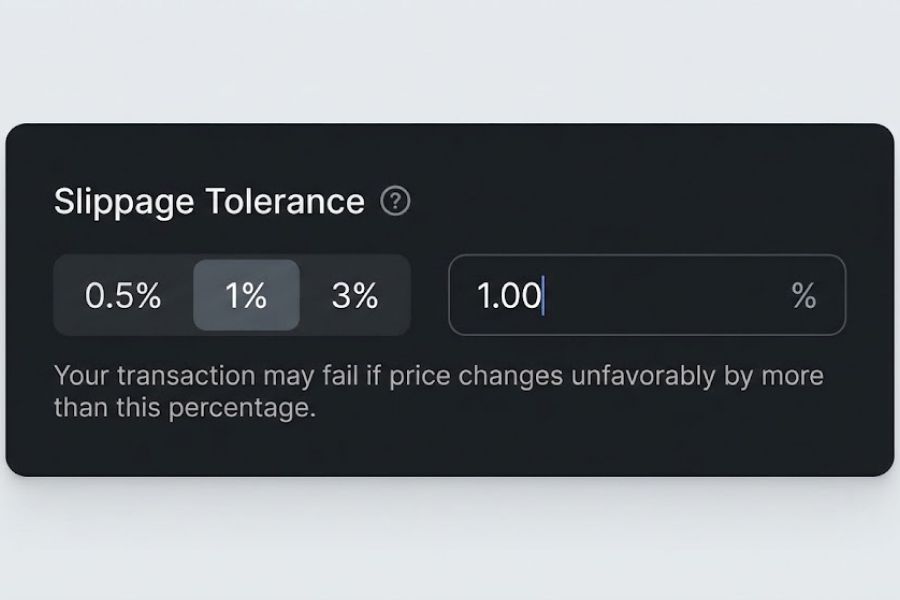
One issue that often shocks novice traders is the side costs. On a DeFi swap platform, you face three types of costs: Network Fees (Gas Fee), Platform Fees, and something called Slippage. Gas fees depend on blockchain congestion, and platform fees go to liquidity providers. But slippage is a different story.
When you intend to swap a large amount of tokens in a small liquidity pool, your purchase disrupts the pool's balance and drives the price up. As a result, the number of tokens you receive is less than you expected. This phenomenon is called slippage in token swaps. Managing slippage is vital; if you set the percentage too low, the transaction won't go through, and if set too high, you might lose a significant portion of your capital.
The table below shows the impact of liquidity on slippage levels:
| Pool Liquidity Status | User Order Size | Probable Slippage | Final Outcome |
|---|---|---|---|
| Very High Liquidity | Low / Medium | Below 0.1% | Precise execution price |
| Medium Liquidity | High | Between 1% to 3% | Slight reduction in tokens received |
| Very Low Liquidity | Medium / High | Above 5% to 10% | Significant loss on trade |
| Volatile Liquidity | Any Size | Unpredictable | Risk of transaction failure |
To prevent these losses, the best approach is to use Aggregators or check Market Depth before trading. Always pay attention to the "Minimum Received" section at the bottom of the swap window before final confirmation. This number shows the minimum tokens you will get in the worst-case scenario. If this number varies greatly from your requested amount, it’s better to reduce your order size or wait for liquidity to improve.
Common Risks in DeFi Token Swaps
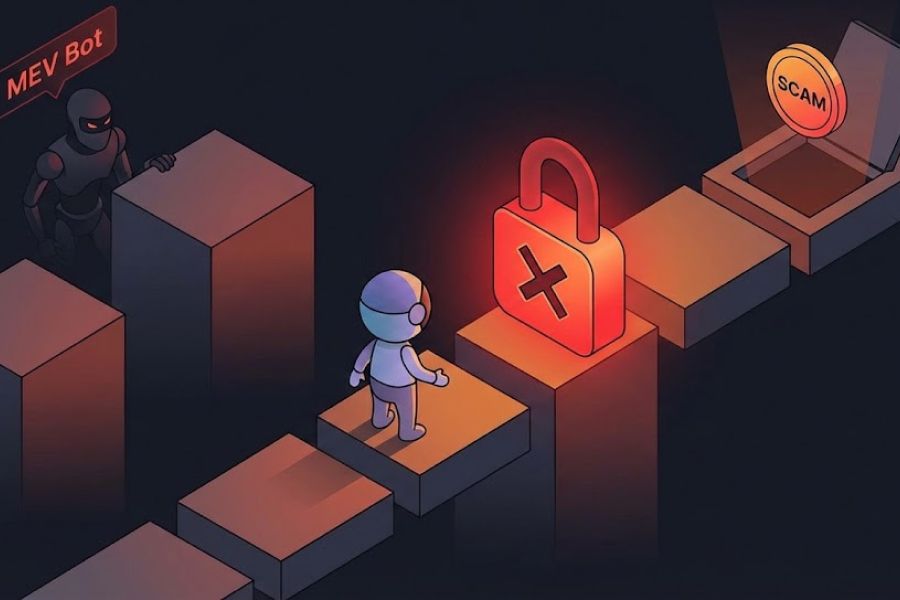
Wherever technology and money intersect, risk exists. One of the main dangers in DEX token swaps is the presence of fake tokens. Since anyone can create a token on decentralized exchanges, scammers mint tokens with names similar to legitimate projects. If you don't check the Contract Address, you might convert your money into a token that has no value and cannot be sold.
Another risk is software bugs in smart contracts. If the platform's coding is weak, hackers can drain the liquidity pool. There is also the concept of Impermanent Loss, which mostly concerns liquidity providers, but knowing it is useful for traders as it affects market depth. You should always use platforms that have been Audited and have a good track record.
Furthermore, there is a phenomenon called a Sandwich Attack. In this method, advanced bots (MEV Bots) detect your transaction on the network and buy just before you to drive the price up, then sell immediately after you to make a profit. To counter this, setting precise slippage and using platforms that offer MEV protection is necessary.
How DeFi Token Swaps Differ From Centralized Trading
The fundamental difference between Centralized Exchanges (CEX) and DeFi swaps can be summarized in one word: "Control." In a CEX, you don't own the private keys to your wallet; the exchange acts like a bank, and if it gets hacked or decides to close your account, your hands are tied. But in DeFi, you are your own bank. This is a heavy responsibility, but it brings endless freedom.
In terms of asset variety, DeFi platforms are usually ahead. New projects are listed on DEXs before anywhere else. On the other hand, features like Limit Orders are more common on centralized exchanges, though modern DEXs are starting to add these capabilities. Privacy is also much more prominent in DeFi; no one asks for a photo of your ID card or utility bill.
Key Feature Comparison Table:
| Feature | DeFi Swaps | Centralized Exchange (CEX) |
|---|---|---|
| Asset Control | Fully user-controlled (Non-custodial) | Exchange-controlled (Custodial) |
| Identity Verification (KYC) | Not required | Usually mandatory |
| Token Variety | Very high (includes new projects) | Limited to listed assets |
| Fees | Variable (Network dependent) | Usually fixed and clear |
| Security | Depends on code and user | Depends on exchange server security |
For those looking for deeper analysis and finding the best entry points in both markets, tools like SIGNAL X can be a suitable solution. By providing precise trading signals including entry and exit points, this system helps traders act with a clearer vision in both centralized and decentralized environments and leverage market volatility to their advantage.
What to Check Before Swapping Tokens
Before you press the Swap button, you must check a few things. The first and most important is verifying the token's contract address. Always take the address from the official project website or reputable sources like CoinGecko and paste it into the DEX search bar. A mistake at this stage is irreversible. The next item is checking the pool's liquidity; if liquidity is low, slippage goes up, and you lose money.
You should also examine the price chart across different time frames so you don't buy at the peak. Checking network fees is also essential; sometimes, swapping $10 might cost you $20 in fees, which makes no sense. Finally, ensure your wallet is connected to the correct network and you have enough balance to pay for Gas. Attention to these details is the difference between a professional trader and a loser.
Final Thoughts
Decentralized exchanges, or DeFi token swaps, are a window into financial freedom and the elimination of intermediaries. By correctly understanding how liquidity pools work, managing slippage, and recognizing existing risks, you can use this space to grow your capital. Don't forget that in this market, knowledge and the right tools are your most important assets. Always research before transacting and use analytical tools to mitigate risks.
GINOX is the most reputable website regarding the first AI-based Smart Suite and Web3 in financial markets. We sincerely appreciate you staying with us until the end of this article and supporting us with your valuable feedback.
Frequently Asked Questions
- What is a DeFi token swap?
This process refers to the direct exchange of one cryptocurrency for another on a blockchain without the intervention of an intermediary or centralized exchange, executed by smart contracts.
- Why does Slippage occur in token swaps?
Slippage happens when your order size is large relative to the available liquidity in the pool, causing an instant price change at the moment of execution. Using platforms with high liquidity or breaking down large orders can reduce this issue.
- Are DeFi swaps safe for beginners?
These swaps require technical knowledge, and risks like fake tokens exist. for a safe start, it is suggested to practice with small amounts on reputable platforms and definitely watch necessary tutorials regarding wallet security.
- How can I ensure a token is real before swapping?
You must check the Contract Address from official sources. Using blockchain explorers (like Etherscan) and token security check services is very helpful in ensuring the project's validity.
- Is KYC required for swapping on a DEX?
No, the nature of DeFi is privacy preservation. For example, on the GIDEX platform, you can swap and manage your assets without any identity verification and in complete anonymity.